

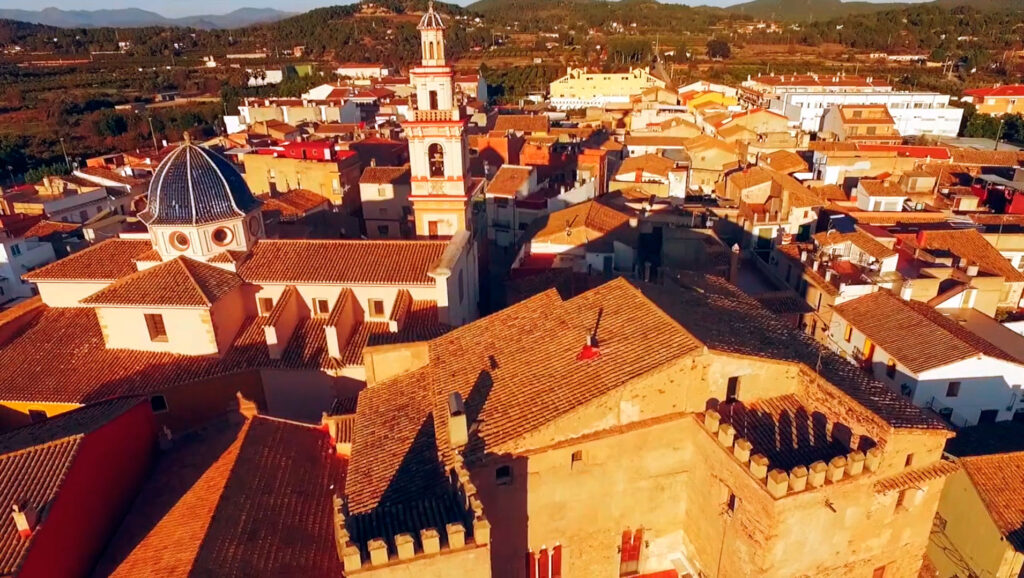
The City Council of Albalat dels Tarongers (Valencia) , in its plenary session held on November 27, unanimously approved the General Structural Plan (PGE) and the Detailed Planning Plan (POP) drafted by AUG-ARQUITECTOS, SLP. The council has already submitted both plans to the relevant environmental authorities for the issuance of their respective Strategic Environmental and Territorial Declarations. This marks the culmination of several years of work during which the company’s technicians, under the supervision of the Valencia Provincial Council’s Technical Assistance Service for Municipalities and in collaboration with the Albalat dels Tarongers City Council, designed a sustainable and realistic plan tailored to the municipality’s needs.
Regarding structural planning, the main objectives of the new General Urban Development Plan (PGE) can be summarized as follows:
- From an environmental and landscape perspective, the allocation of the appropriate level of protection to a portion of rural land, necessary to safeguard its values, as well as the zoning of rural land with a simplified approach that avoids the introduction of artificial distinctions. This justifies considering all land located south of the A-23 motorway as protected (natural or agricultural), incorporating a precise delimitation of all uses, and in particular, those with the greatest environmental impact. In this respect, the provisions of higher-level protection designations, especially those associated with the Sierra Calderona Natural Park, are incorporated into the planning framework.
- Regarding non-urbanizable land, in addition to including all sector-specific regulations (livestock trails, public water domain, etc.), emphasis is placed on the detailed identification of illegal buildings throughout the designated area, distinguishing between two types of situations: those that can be legalized, either collectively through Special Plans or individually (according to the mechanisms established in the TRLOTUP). For these purposes, the PGE (General Urban Development Plan) defines, as a guideline, 48 areas subject to territorial impact minimization, covering 1,502,975 m², in which 956 plots of land were built upon at the time of its drafting.
- The identification, based on official maps and following field visits, of areas with a high risk of forest fire throughout the southern part of the municipality (south of the A-23 motorway), so that the competent authorities can adopt appropriate measures and so that this circumstance is taken into account when assessing the possible legalization of the homes most exposed to this risk.
- The preservation of areas with natural risks from new development, maintaining only sealed soils of historical origin.
- The intention to freeze the polycentric model, avoiding an increase in land use. Therefore, in urban developments, the policy followed in this plan has been to avoid increasing the land area and, if necessary, to organize it based on more detailed mapping, which has allowed for the final identification of streets that were not previously mapped and the rezoning of small areas of urban land. All of this falls within the framework of a detailed planning analysis, which, from the outset, also had to be incorporated into the structural planning.
- The adjustment of the growth projections for designated land to the thresholds established in the Territorial Planning Scheme of the Valencian Community (ETCV) and to the municipality’s actual expectations, from a perspective of containment. Specifically, and in light of the report from the Deputy Directorate General for Territorial Policy and Landscape, the decision was made not to increase the amount of designated land for residential or industrial use, taking into account the amount of vacant land available. This decision, however, was imposed and is justified by the need to move the plan forward, avoiding confrontations with a regional government whose criteria will always prevail over those of the city council.
- The identification of all local heritage and its protection in the corresponding Heritage Catalogue, so as to guarantee its preservation and foster appreciation and respect for it by residents and visitors. In addition to the archaeological sites and the extraordinary stately palace that dominates the town’s image and could become a key element in the urban renewal of the riverfront, the town has a Historic Center with a good urban layout, but with many inappropriate elements, which justifies not proposing its protection as a Historic-Artistic Site of Local Interest (NHT-BRL). All of this without neglecting the establishment of measures to prevent the degradation of the urban landscape and the trivialization of architecture, which has occurred in recent decades.
- The delimitation of provisions regarding green spaces and facilities, especially for school and sports use. The plan also suggests some actions regarding road traffic around the town center of Albalat dels Tarongers and from there towards the La Caixa area. While these are not specific to the plan itself (since their implementation cannot be financially attributed to its development), they can serve as a guide for other bodies, such as the Provincial Council of Valencia, as they include concrete proposals, discussed with the town council, that are limited in scope but whose implementation is beyond the local capacity.
- The incorporation of urban planning regulations adapted to all current sectoral regulations, supra-municipal protection designations (Natura 2000 Network), and current regulatory criteria for this type of area. Regarding building regulations, without altering current building typologies, it is necessary to implement regulations for the Historic Center to curb its deterioration.
- The development of an inclusive plan that takes into account the most disadvantaged groups and promotes sustainable mobility, encouraging the use of bicycles for short urban journeys and also as a recreational activity, thanks to the connection with the newly opened section of the Ojos Negros Greenway.
Regarding the detailed planning, the main objectives of the new POP (Plan of Operational Planning) are summarized as follows:
- Incorporate the detailed planning into high-quality maps, overcoming the serious errors present in the current planning. Therefore, to provide precise maps on a new cartographic base and to use current criteria for translating the content of a POP, including its provision in digital format, for the purpose of accuracy verification.
- Respect the current planning and introduce minimal changes to the ordinances, as they are understood to correspond to efficient and consolidated models, in which innovations should be limited to what is absolutely necessary.
- Incorporate urban planning regulations adapted to all current sectoral legislation and criteria, as well as to the requests of the city council within its jurisdiction, particularly regarding the conditions for obtaining licenses in the case of the developments along the Segart Road and Pla de Pavía, due to the difficulty of connecting these areas to a wastewater treatment network, at least for the time being.
- Develop an inclusive plan that takes into account the most disadvantaged groups and promotes sustainable mobility, encouraging the use of bicycles for short urban trips.