

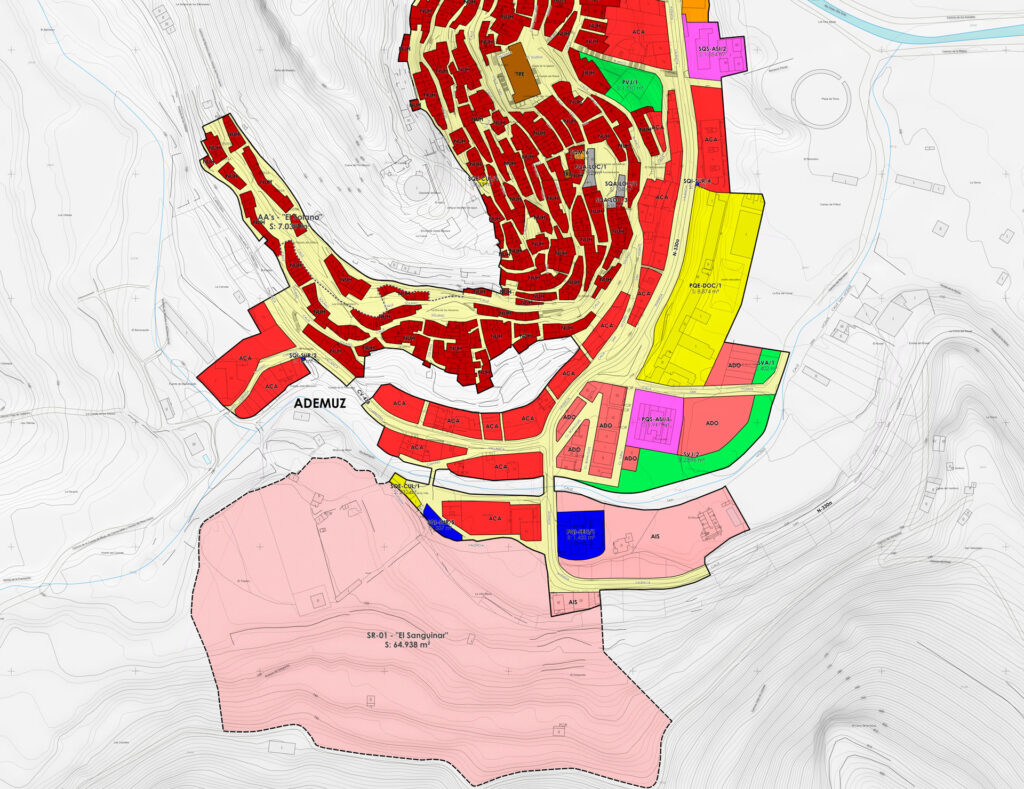
On June 19, 2025, the plenary session of the City Council of Ademuz (Valencia) agreed to approve the Final Proposal for the Structural General Plan (PGE) and the Detailed Ordination Plan (POP) and to submit it to the regional and local environmental bodies for the purpose of issuing the Strategic Environmental and Territorial Declaration (DATE). With this decision, the plan receives a new and decisive boost toward its final approval, as immediately after receiving the DATE, the city council intends to submit it for final approval.
This plan is accompanied, as required, by a series of complementary documents and studies, among which the Cultural Section of the Catalogue of Protections stands out, as the town is rich in a broad and varied heritage. As is customary in the work of AUG-ARQUITECTOS, SLP, great attention has been paid not only to the development of rigorous and precise plans, allowing for simple and unequivocal application of its determinations, but also to the study and protection of the entire heritage. Not surprisingly, the Rincón de Ademuz region as a whole, and the municipality of Ademuz in particular, is an area in which many professionals in architecture, archaeology, ethnology, and paleontology have for years promoted a culture of respect, research, and innovation. The Cultural Section of the Catalog of Protections alone includes specific protection for 661 elements, including seven Assets of Cultural Interest and 384 Assets of Local Significance.
The Ademuz PGE-POP (structural general plan and detailed ordination plan) is a project that AUG-ARQUITECTOS, SLP has been developing since 2019 and could be definitively approved in the second half of 2026, if the DATE (Statement of Administrative and Property Rights) and the report on property assets are issued within a reasonable timeframe. The plan will replace a Subsidiary Regulations definitively approved on May 4, 1993, a partial industrial use plan approved on June 28, 2002, and 11 specific amendments, of which 8 have been definitively approved and three are currently being processed. There is no Consolidated Planning Text, and the current planning clearly shows signs of being unsuitable for current reality and needs.
Regarding structural planning, and leaving aside the need to adapt local planning to the new legal framework that regulates land use planning, urban planning, landscape planning, and heritage, as urban planners, we must emphasize what, in our opinion, must govern any decision that may be taken regarding the future of the town, whether it comes from the local administration or any other. We are referring, obviously, to the need to articulate measures and a model (in this case, urban planning) that contributes to combating depopulation; that is, that includes planning decisions tailored to the reality of the municipality, implementable, and extremely simple to manage. If the European Parliament considers that areas with a population density below 8 inhabitants per square kilometer, in Ademuz, with a population density of 9.96 inhabitants/km², are at extreme risk of depopulation, it is necessary to consider the following: , compared to a provincial average of 241.14 (ARGOS 2022) and a gradual process of population loss, should raise alarm bells.
Faced with a worrying demographic outlook, Ademuz has sufficient resources to guarantee its sustainability, preserves an agricultural sector that must be promoted and preserved, has mineral resources, and treasures a landscape and heritage of extraordinary interest. The rich landscape, natural, paleontological, ethnological, archaeological, and architectural heritage place this town among the municipalities with the most relevant and varied heritage in the Valencian Community. The state of conservation of this heritage and the sensitivity of the inhabitants of this land, who, with few exceptions, have been able to enhance it thanks to the commendable involvement of some of its residents and architects, historians, archaeologists, and other professionals, are solid elements on which to base the plan’s proposals. The City Council, for its part, has demonstrated its commitment to the conservation of cultural heritage by supporting a large number of initiatives, including the drafting of a Catalogue of Protections for the Historic Center of Ademuz, which, after several years of processing, was not approved for reasons beyond the City Council’s control.
The objectives of the new Master Plan are summarized in the following ten-point plan:
- From an environmental and landscape perspective, the attribution of a portion of rural land with the degree of protection that is appropriate and necessary to safeguard its values, as well as the zoning of rural land with the greatest possible level of detail, incorporating precise delimitations of all uses, particularly those with the greatest environmental impact, i.e., extractive uses.
- Regarding protected non-developable land, the establishment of regulations that, to ensure its optimal conservation, allow for the activities that have traditionally been carried out there (and have allowed us to enjoy the territory that Ademuz offers today), as well as other activities related to leisure and adventure sports, etc.
- The preservation of areas where there are natural risks, specifically flooding and new growth, maintaining only sealed land of historical origin. In this regard, developable land is limited to an area that, following the corresponding Flood Risk Study, as required by the Territorial Management Service in its report of November 12, 2021, was confirmed not to present this type of risk.
- The adaptation of the growth forecasts for sealed land to the thresholds required by the Subdirectorate General for Territorial and Landscape Planning and to the municipality’s actual expectations, from a containment perspective, which is compatible with the incorporation into urban land of some peripheral areas of the villages, where there are buildings of historic origin and great heritage value. This adaptation to the ETCV growth thresholds (although not binding but rather guiding, as of December 2024) is based on a detailed analysis of vacant land and the conditions of the areas that the NNSS had planned as new development zones and which, after several decades without development and in view of the inadequate position they would occupy, are being declassified in the Master Plan.
- The provision of productive land to continue implementing business creation and the orderly transfer of some activities to the existing industrial sector. This land is located in the industrial estate promoted by the public administration, whose surface area had to be reduced to meet the maximum growth standards established by the Territorial Planning Service at the time.
- The identification of all local heritage and its protection in the corresponding Catalogue of Protections, ensuring its preservation, fostering appreciation and respect for it among residents and visitors, and interpreting this wealth as the basis for promoting quality cultural and leisure tourism.
- This catalog is an extension to the entire territory of the Catalogue of Protections of the Traditional Historic Center of Ademuz, which the city council attempted to promote. It should be emphasized that, from the perspective of the General State Budget (PGE), the Traditional Historic Center of the village of Sesga will also be granted the status of a Site of Local Relevance. And it assumes among its determinations and confers a normative character to the CATALOG OF DRY STONE IN THE MUNICIPAL DISTRICT OF ADEMUZ BARRACKS AND ISOLATED BUILDINGS (2022), by generically protecting these examples of vernacular architecture, within the ethnological part of the Cultural Section. Some buildings also have specific protection for specific reasons.
- The delimitation of the perimeter of urban land in all villages and the articulation of a regime that allows the recovery of buildings.
- The delimitation, in due measure, of the provisions for green areas, school facilities, and housing subject to some form of protection, although many of these provisions seem excessive and unnecessary.
- The incorporation of urban planning regulations adapted to all current sectoral regulations, supra-municipal protection schemes (Natura 2000 Network), and current regulatory criteria for these types of areas.
- The development of an inclusive plan that takes into account the most disadvantaged groups and, in particular, the elderly, whose increasing importance exists throughout the municipality.