

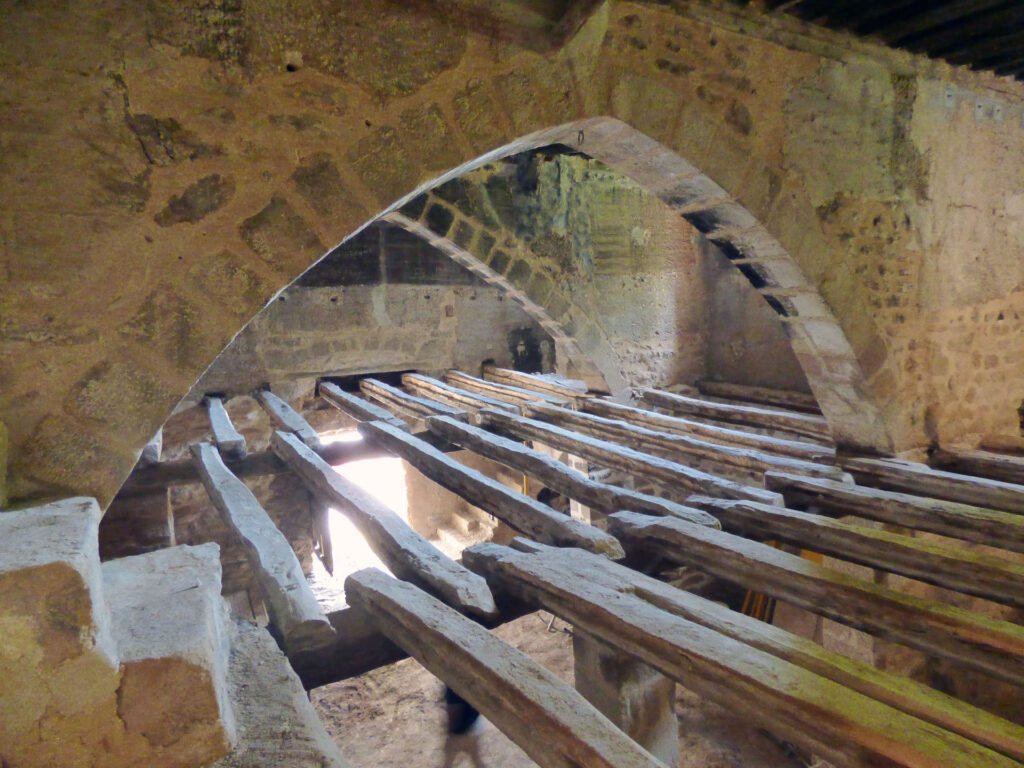
The first phase of the rehabilitation of a public building used as a multi-purpose service facility in Alpuente (Valencia) has been completed. The works, promoted by the City Council of Alpuente, were carried out during the first half of 2025 according to the project drawn up by architect Rosa Briso de Montiano García and under her direction, and with the corresponding archaeological monitoring.
The project is part of the rehabilitation of a medieval building that preserves interesting stone structures and had been abandoned for several years, during which time the building began to deteriorate.
The building being renovated is located in the traditional historic center (NHT-BRL), within the walled enclosure surrounding Alpuente Castle and the current Church Square. Specifically, it is located next to the parish church of Nuestra Señora de la Piedad, on a corner position, with three facades facing the public street and a dividing wall facing the Town Hall, rebuilt about ten years ago. The complex bridges a significant difference in level between the two opposing main facades and forms part of the urban landscape of the town of Alpuente. The lower entrance is via Amargura Street (basement floor) and the upper entrance is via Calle Rey Don Jaime 7 (ground floor). From Amargura Street, the building has a ground floor, two floors, and a basement level, at floor level (three floors). From Rey Don Jaime Street, the building has a ground floor plus a basement level (one floor plus a basement level).
Regarding the uniqueness of the construction elements, the following stand out:
- The complete development of large pointed arches, located on the lower ground floor, as in the adjacent buildings in the same block in which it is located. These arches are not preserved in all the buildings.
- The vertical development of four stone pillars, which rise from the ground floor and support the current wooden roof. These pillars, all different, come from another building and were relocated to serve as support for the roof. The unique shape of the pillars—an octagonal shaft, a slender, truncated cone-shaped shaft, a disc-like capital, and a capital with corner finials—suggests that they most likely date back to before the 13th century. They are currently positioned unevenly, using capitals as bases and fitting some pieces together.
- The complete development of a stone staircase that connects the lower ground floor, the mezzanine, and the ground floor. It begins in the basement with a curved shape, and the rest is entirely linear. It is unique for being entirely made of ashlar steps and for being completely preserved.
The primary objective of this PHASE 1 of the project was to carry out work only inside the building, consisting of: cleaning, demolition, and restoration of various elements in the basement, mezzanine, and ground floors, as well as the occasional replacement of some wooden beams in the mezzanine ceiling. Subsequently, interior consolidation work was carried out on the arches and walls of the basement and mezzanine floors.
The cleaning and demolition of various elements are essential preparatory work for the next phase of the renovation project. This also helped to relieve the load on the building, allow for greater leeway and safety, and provide the capacity to respond to unforeseen construction events.
During this demolition phase, some materials were recovered, such as stones used in the masonry walls, hand-fired clay tiles, hand-glazed clay tiles, door frames, old wooden doors with hand-carved panels, and any other material that can be recovered for the project itself.
On the lower ground floor, the loose soil was removed without any excavation. The staircase leading to the mezzanine and the distribution partition walls were demolished to prepare for the future restrooms. The mezzanine ceiling joists were removed (as shown in the photo illustrating this article), and the wooden beams were left to support the stone arches.
On the mezzanine, the remains of the existing interior partition walls were removed.
On the ground floor, the interior partition walls in the area where the future restrooms will be located were removed, and the entire clay floor and all wooden doors were removed for later restoration.
The occasional replacement of a wooden beam that was in poor condition was carried out with another wooden beam, complying with the same specifications and dimensions as the existing beam, as well as with current regulations and subject to approval by the project management.
The interior consolidation of walls and arches has been one of the priority and essential tasks for undertaking the complete renovation of the building. The disintegration of stone, rammed earth, binder materials, and mortar ran the risk of the walls losing their load-bearing capacity. To this end, consolidation and reinforcement materials were used, primarily in the basement, which provide stability and are fully breathable, following similar construction techniques to traditional ones.
The restoration of the building aims to recover and enhance the existing architectural spaces. The structure of ashlar arches, stone walls and pillars, floor coverings, interior carpentry, and other materials make this building a space suitable for restoration, in which a focus on all these elements must be prioritized, and these must be duly identified in the restoration project.
The restoration proposal was completely respectful of the existing structure and was executed using manual techniques and traditional materials that enhance the architectural and spatial value of the building.
The project was respectful, not seeking to indiscriminately replace the old, but rather to preserve it to interact in an enriching way, with a contemporary vision of architecture and the use of this type of space.
The building required urgent structural intervention to ensure that the significant existing deficiencies were not exacerbated. The construction solutions were necessary to reinforce and stabilize the property, allowing it to serve its intended future use. All of this was carried out with great professionalism by the contractor, with absolute respect for vernacular architecture and traditional construction techniques. It was also essential to use as many materials as possible, recovered from the construction site itself or from demolition sites, which were used primarily for certain finishing touches and finishes.